The Skipper’s Notebook (Blog) 快艇船長筆記簿 (博客文)

  • The Case for Mandatory Licensing for Boat Operators

    At age 16 I felt that the Swiss rules for speedboat renting for those without a licence was certainly bordering on the more restrictive. Furthermore, I had a physical deficiency — in spite of goggles and the like, I found it incredibly difficult to keep my head down, in, under the water for anything more than a split second. Fully aware any licensing tests could involve this very move, I intentionally delayed getting such a licence (and was left with much slower boats, or row-/pedal-boats).

    The Swiss are remarkably visible in the boating world in spite of us being a landlocked country. Think about it — you associate army knives, chocolates, and epic ski resorts (and brilliant trains, let’s be honest) with our country — the last you’d think of are boats. But we are very present on the boating world — and we have some incredibly demanding tests. Our “blue-ocean” boat licence (the Hochseeausweis) is not a regular licence granted after a RYA Powerboat 2 course — think more a la RYA Yachtmaster Offshore or Ocean as a permit to put our “famously neutral” (although some have since doubted it) white cross on the stern of your ocean-going vessel (and if you have these two RYA tickets, you actually can get it directly converted to our Swiss “blue-ocean” boat licence, apparently).

    Probably the biggest (and most adventurous) mistake I could have made was to treat Auckland, New Zealand, as “yet another Zürich” when I asked Auckland Boat Hire for a hull our family could rent (which worked!). Throttles in Switzerland were limited without a licence — the one I had on Lake Jinhai in Beijing (under special arrangements) was unlimited (boop!… I felt the thing taking off as I pushed down hard on the throttle). But it was on the waters by the Waitematā where I felt we could go beyond 5 knots for the first time.

    it was exciting — but also adventurous. Thank Heavens I treated the pre-launch briefing seriously — this was, to me, not so much “between customer and service provider”, but between two mariners (one with experience, and one slowly building up that). The hull and all gear onboard were examined clinically, and RISK ASSESSMENT was a huge thing. I will admit that the wind did keep us off our planned course from Hobsonville to Half Moon Bay (by a bit)… although there were no serious “close calls”, and I handled the throttle with care (starting smoothly instead of just slamming it down), I felt there were, in retrospect, so much we could improve on.
    Almost right after we got home that evening, I was more than interested in how to get behind the helm right — this time, armed with information, and knowledge. I kind of forgot the queries I threw AI (and I did check twice, aware it could hallucinate), but somewhere we ended up talking about boat driver licensing — and BoatUS and its NASBLA Boating Safety ID Card was the first point of call, as all lessons were online, and you got an actual, valid licence. And then right after that was Canada’s PCOC (Pleasure Craft Operator Card) — which proved to be both more understandable, and actually harder with the questions. I did admit to “steering blind” at times — thankfully, the mandatory 24-hour cool-off period gave me plenty of time to review content before a second, and at this time, more successful attempt. (The PCOC proudly sits today right after my Mainland Chinese driving licence for vehicles in my wallet of licences.)

    My courses now chart me to more ‘boating tickets’ abroad, including some in Asia, Europe, and Oceania. (Spain’s LN licence is an interesting one, granted to you after just a six-hour course — and there’s nothing wrong with having too many licences!)

    The US and Canadian models are open for people the world over — and in the case of the ticket from Florida, free of charge for all from BoatUS — so I would absolutely recommend anyone who thinks of spending time on the water not as a swimmer, to get one. I’m saying this because the language of the water can be different from that one on the highways (although the Cevni signs are extremely user-friendly).

    The water doesn’t give you a second chance when you make mistakes, and waves and conditions on the water are actually far more brutal than the most challenging parts of Desert Road on New Zealand’s State Highway 1. If you thought “off-line” (ie: not on the motorway itself) service areas in Ireland or New Zealand were an inconvenience, consider being say stuck somewhere on the fairways in the midst of Hong Kong water with your engine dead! Vessels, and how to pilot them, work massively different to vehicles. A KABOOM! is never a good way to end your journey, but on the water, it can actually be far more serious — and brutal.

    I’d like to see, globally, mandatory licensing of all boat operators. This doesn’t have to be an impossible PhD to crack — in fact, Canada and the US are showing how it can be done. It would, then, be far better if you took to the helm at least aware what the water is throwing at you. You can call me a rules-obsessed Bünzli from Zürich, Switzerland — or you can call me an average human being who wants to take his family out on the water — SAFE — with a Vegemite sandwich pre-launch, and return, in one piece, ready for the Cappuccino to close out the sailing…

    PS: I was incredibly surprised — relieved, even, when all the speedboat tests did not require me submerging my head under water!…
  • Making Sense of New Zealand’s New Life Jacket Rule

    New Zealand now mandate life jackets for vessels 6 metres or less in length. Here’s how I think — especially as someone who’s actually been on the water there.

    The water is more dangerous than you think
    I’ve been driving cars across all five continents — Europe, Asia, Africa, the Americas, and Oceania. On the road, if “stuff happens”, you pull to the side, call the RAC / AA / police, and it gets sorted. This doesn’t work in the water. Neutral sometimes doesn’t cut it with the throttles. And at times, it’s not as easy as just dropping anchor. And for moving incidents, it’s far more precarious — if you go overboard, that’s a serious incident.

    As recreational boating has become more and more accessible, we’re seeing more boaters on the water. Back in 1998, in Zürich where I started, life jackets were sometimes an afterthought — especially for those cruising on limited-horsepower engines. Today, having done runs in the Waitematā and beyond, it’s clear you need them on.

    Even when they were optional, to me they were common sense
    For my August 2026 runs, I actually had the legal authority, as the skipper, to tell my family not to wear them. I decided to keep them strapped as everything was new. Today, the rules have been dialled up — you now need them, on boats I own or skipper, whilst you’re still on terra firma. Excessive skipper dictatorship? Turns out the part right by the docks can in fact be incredibly slippery, especially after rain!

    I would think of it more like a seat belt rule. If you fasten your seat belts as you are about to set off on the roads, we need something on the water — and life jackets are pretty much what you are looking at.

    Peace of mind in an open boating culture
    Boating in New Zealand is basically open to all — you don’t even need a licence. That gave me my chance to do a run in Auckland and Taupō. I think the least you can do is to ensure you stay safe — and a lifejacket is probably how we should start things off with.

    So on my vessels, you’ll see — from Auckland to Amsterdam, Macau to Mauritania — an absolute life jacket rule that ties itself on when you’re about to head to the docks and stays on until you leave the water and are back at the marina. The water doesn’t give second chances. It’s the only way forward.

  • This is David Feng and his Skipper’s Notebook…

    “A good skipper is an alert skipper” — I still remembered those words from my Auckland run. This is my online notebook about the boating world.

    There’ll be both a fun run-through of all runs I did (so some posts will be backdated), and a look at how I see things in the boating community.

    What’s the vibe my end? Helm experience since age 16 on Lake Zürich with a marked Antipodean tint — runs in Auckland and Taupō, a mandatory Vegemite ritual pre-launch, the right mix of “she’ll be all right” and Swiss precision when making way, permanent Lauterbach-level risk assessment and mitigation combined with a desire to crack a few hearty jokes, and to pilot the hull just so smooth like a good HSR train where Jr can feel free to have fun with dominoes even on the water…

    Yeah mate, she’ll be all right… now let’s give that diver to the left and sailboat to the right a fair bit of extra space… make it nice and easy for all on the water…

  • Taupō: First ‘Licensed’ Run — and More Alert and Aware

    10 August 2026 Lake Taupō Run

    I must say — the run I just did in Auckland was spectacular. As in: the views, the speed, but far more, the fact that I now knew I had to brush up on my navigation knowledge. Far East wisdom states — To know that you do not know is the highest wisdom; to think you know when you do not know is a sickness.

    Fully aware of this, I finished and passed NASBLA and PCOC licensing/certification. None were straight passes: frustratingly, my first shot at Canada’s PCOC had me missing by just 1%, whilst the US NASBLA (Florida) marked me down a few more points. I admit, this being new to me, some of this was guesswork to start with, but I redid it and gave far more attention to the details. My second go for the NASBLA ‘ticket’ (licence) was higher, and for PCOC, visibly higher. The courses finally fulfilled my RTFM need — for once, I knew what I was supposed to do. Hitherto alien to me, Colregs and basic navigational rules were a breath of fresh air. And the one rule I remembered now — the water was deceivingly similar to Swiss roads — give way to what’s to your right!

    We arrived at LAKeFUN in Taupō to absolutely glorious views from the approach road in our vehicle, with me having done my homework — I was well aware that there was a part to the southeast of the lake which was certainly not built for “sending it” at high speed, and where you had to be super alert! After everyone had their life vests fitted, a brief briefing on land and on the hull, and final pre-departure checks and procedures completed, we were good to go. 5 knots on the way out — increased, of course, I’d always do like a good HSR train — progressively to 10 knots and beyond.

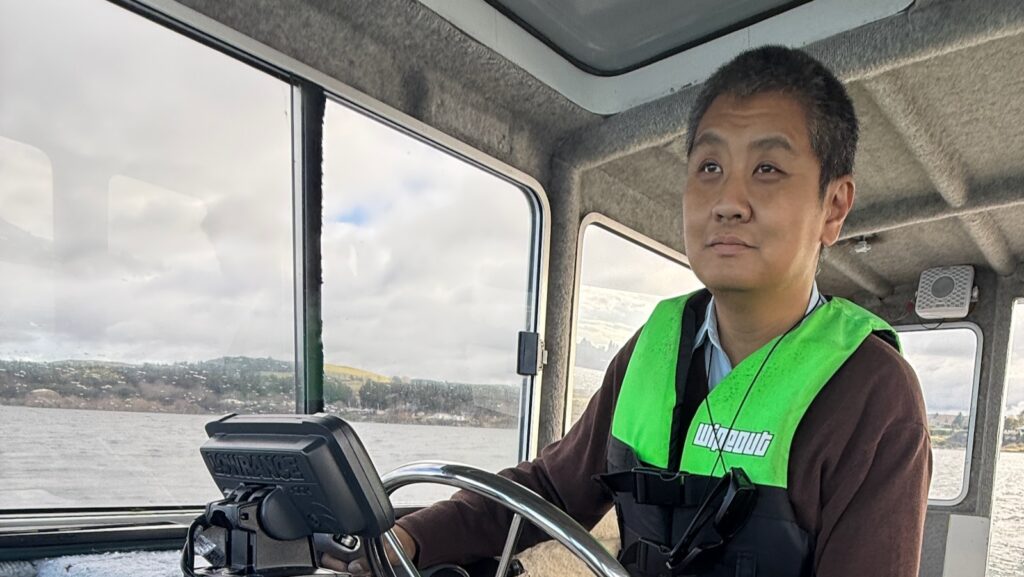
    The boat in Auckland had pretty much “the works” — the GPS gave us a good view of how fast we were going. The Kiwi, as we took it out, had something different — a windscreen wiper! It would actually be put into frequent use as the waves were actually choppier than we thought — but the good thing was we piloted from inside the vessel. Any lack of speedometers was fixed by me using my iPhone, and thanks to a bit of conversion utilities, I was able to max out my run at 18.4 knots, although we usually hovered more around 15 knots. We didn’t intentionally try to force it to “plane” — the water was not hugely optimised for that, as I saw, and we were mostly trying to locate the Māori Rock Carvings nearby.

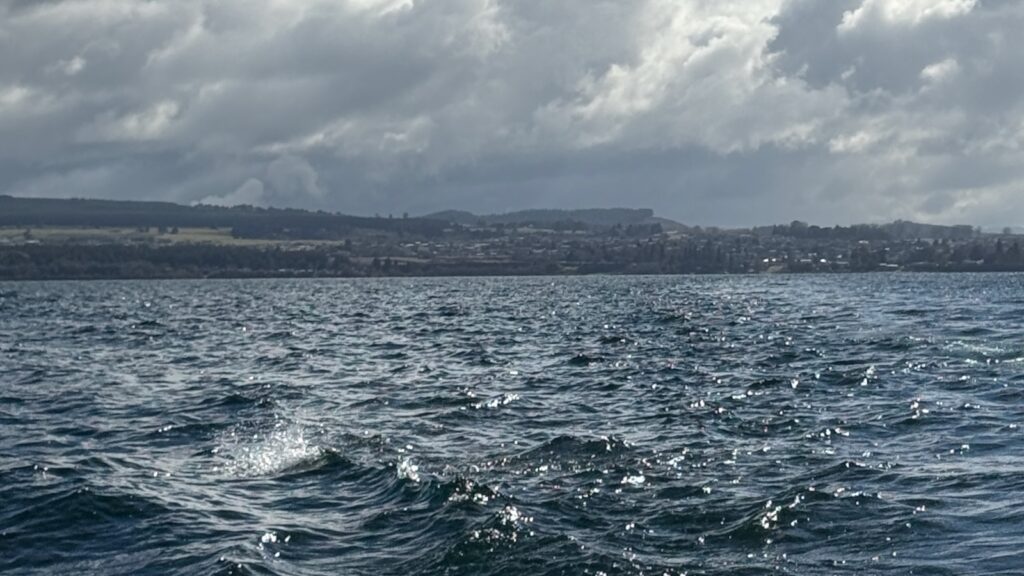
    Lake Taupō was very different from Auckland. There, you were never too far from the city. Here, there were parts of nature that were far more quiet. Lake Taupō threw us some confusing curveballs, such as when I though I was headed back to the town, whereas I actually went pretty deep into Whakaipo Bay (I was ‘seeing land’ too soon!). Finally, after around ten rather nerve-wracking minutes (when Google Maps didn’t do its best), we were finally back in Tapuaehauru Bay — which led us back to Central Taupō.

    Having been passed in Auckland by another boat, I defensively executed a “wave chop”; in Taupō, I mandated a minimum distance of 250 metres between me and the other boat and dipped speeds so to generate as little wake as possible. My wife took pictures of the lake as we were cruising by — these were awe-inspiring. One of our goals was to see the Ngātoroirangi Mine Bay Māori Rock Carvings — we’re still a little in dispute if we saw it, with me aware we caught sight of something like that, but the wife not too certain.

    Still, it was a refreshing cruise — the helm was inside, so our boat was able to handle some visible chop, but it was always manageable — Jr was even able to have some fun with his dominoes inside! I was able to best my Auckland speed record with a new one. When we returned the vessel, as per instructions at launch, I completed the U-turn, gave the throttle a brief roar, then dipped back down, and we touched land far smoother than I thought I would.

    I have to say, getting a licence is a big thing — especially when you’re focused and crash through two in a short period of time. Some things become baked into you right when you learn — such as red for port, green for starboard, the five short horn ‘toots’ for a, well, salty maritime “WTF DUDE!?”. It made me visibly more confident taking the helm, now for the first time as a ‘licensed transport amphibian’ over land and sea. Both launch and return were optimal, a good run before we headed later in the day over Desert Road. And, of course, Cappuccino right by State Highway 1 as we headed towards Palmerston North…

  • Auckland: Not (Just) “Yet Another Zürisee”

    02 August 2026 Auckland Run

    Our family has a tradition of taking to the water in any major city we’re in for a fair while, and this is very true across Europe. Hence I did have quite a few runs on Lake Zürich from either end — Zürich and Rapperswil. Hitherto our boat rentals were on predictable territory, almost always Lake Zürich in Switzerland. A run there was familiar, but never boring.

    Having being in Auckland for around half a month by now, we were thinking — how could we get our feet wet here? Although I was certainly a Trains guy, the magnificent views of the water — which always excited my wife, and increasingly me too, got me thinking — and more the Zürich way. We thought Auckland would be “just another city on the water” but what awaited us was an epic run I will never forget.

    In very late July 2026, I started using AI, specifically Google’s Gemini service, to find if there were any places to take a boat out. (This came after I finally un-banned AI in May 2026, after early tries around 2022 on ChatGPT, and later on, Grok, turned out to be frustrating for me, myself also being made aware of the very real threats posed by this technology.) Auckland Boat Hire turned out to be a place to get them, and I emailed the rental company expressing an interest. Something in me told me I should also email them with a basic overview of who the driver — that’d be me — was, this being unfamiliar territory in a new land. Our boat rent request was greenlighted, and we were good to sail.

    We met with the gentleman from the rental company fresh and early on 02 August 2026, after our sailing had been confirmed just the afternoon before. (This being the Southern Winter, we wanted to make sure the weather was fit — which it turned out to be more than that.) For the first time, we were handed a speedboat that could easily run at speeds many times faster than in Zürich, and I used this chance to break my personal maximum speed with ease. But before that, it was a serious look at the hull — and a check on just about everything. Far from bureaucratic, me and the renter, we took it seriously as a co-briefing — understanding how every switch worked, how not to get lost, which parts to keep well away from (we were headed to Half Moon Bay), how fast we were supposed to go, and details — and you know, to Swiss, that’s certainly something for us.

    Although I had been slamming down the throttles in Zürich at the young age of 16, this rental in itself was not totally new to me — indeed, very elementary terms were not alien to me at all. (I was for a brief time a regular reader of Motor Boat and Yachting, before my parents found my obsession and, being from Mainland China, cracked down on it hard — only as authoritarians would, as I was preparing to sit my APs in Switzerland.) More importantly, as of late, within over half a million kilometres clocked in on the Chinese railways, my pre-launch obsession was not so much SENDING IT (as in make the boat jolt from zero to maximum in no time). China’s HSR trains (which extended into Hong Kong) were legendary for being smooth. In fact, I spent much of the wee hours of 02 August 2026 listening to — as a maximum rail geek — the noise of the engine on Hong Kong’s Vibrant Express, to get a feel of just how gradual the acceleration would be.

    The sailing would be a fresh start to me. Everything was both new and familiar to me as a seasoned skipper. What was absolutely most exciting was the way we were headed — straight in the direction of the open ocean, think about it… (although we really did not go far!) To be honest, it was hard getting sleep before this journey as the whole thing was exciting — electrifyingly so, even. A great breakfast of a simple Vegemite sandwich with lots of Anchor butter kept me going for the full six hours — this is now an absolute, permanent pre-run requirement my end.

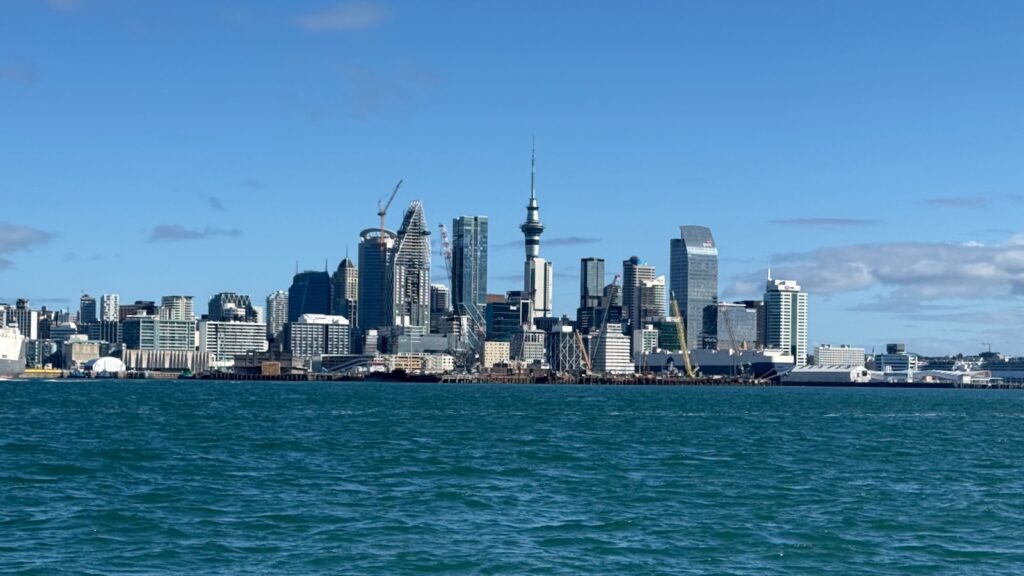
    This being the first time we were handed a boat right from land and launching it in the water (remember that with previous runs, the boat was already primed and good to go), we just hiccuped a bit on launch, but soon we were moving in the water — and sailing smoothly, although carefully, out from Hobsonville Marina. Going to the harbour on land, the Auckland skyline was very clearly visible; in the water, it appeared to play hide-and-go-seek, but we soon headed towards “the bit between red and green poles”, and headed out.

    On Lake Zürich, it was a “regulated free-for-all” at times, so we saw boats going pretty much everywhere. With me at the helm sat on the right, I thought it would be like on the roads, so on occasion we hugged, rather unconsciously, on the side we weren’t really supposed to be in (but still within the fairway). One thing we did learn, though, was a requirement to give way and be nice to sailboats — this would be tested by me minutes into our sailing, when I remembered a motor vessel actually started mixing in the sailboats — to my alarm, wondering if they were all right. (When we returned to Hobsonville, I gave the sailboat right next to me plenty of room, and dipped down to around 5 knots.)

    I wasn’t quite aware how far we would go — but I was in no hurry to “send it” at maximum speed. We hugged the 5 knot limit for much of our journey through the Waitematā Harbour, avoiding controlled areas and AT ferries, and sailing carefully in the quarantine zone. Once we were beyond this part, speed was increased as we kept well clear of Bean Rock Lighthouse — as we were advised.

    There were slight hiccups on our way to Half Moon Bay, including when we lost bearing, when the boat was apparently being “swept” off course by some slightly heavier than expected winds, and, amongst others, finding the approach to Half Moon Bay looking particularly shallow. I almost wanted to touch the water itself, seeing the sonar readings claiming we were “-1 metre” deep into the water — and repeated negative readings convinced me — in spite of Half Moon Bay not too far out (the idea was to get more fuel, and take a quick toilet break) — that we were far wiser heading back. So back it was, and, avoiding the buoys, we made it back — east of Achilles Point, in open water, I clocked the fastest run this sailing at 14.5 knots. Slight southeast of Rangitoto Island, we joined the main fairway back to Central Auckland, avoiding Bean Rock Lighthouse once again, and dipping our speed once we were in the main harbour.

    The run was smooth — remember, at the helm was someone whom, “pampered” by the railways, settled for nothing less smooth handling, smooth speeds, and (absent some pretty random waves) smooth navigation. At one time, both the wife and son fell asleep — which actually elevated my alertness, as I was fully aware the worst way to jolt them would be — to have an incident. Eventually, they woke up to some world-class scenery by the Haruaki Gulf.

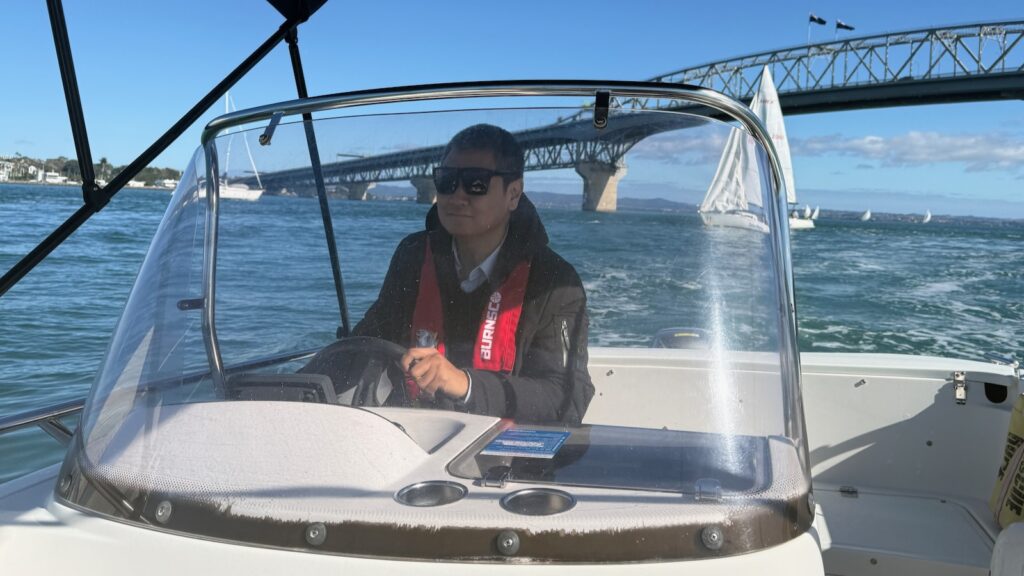
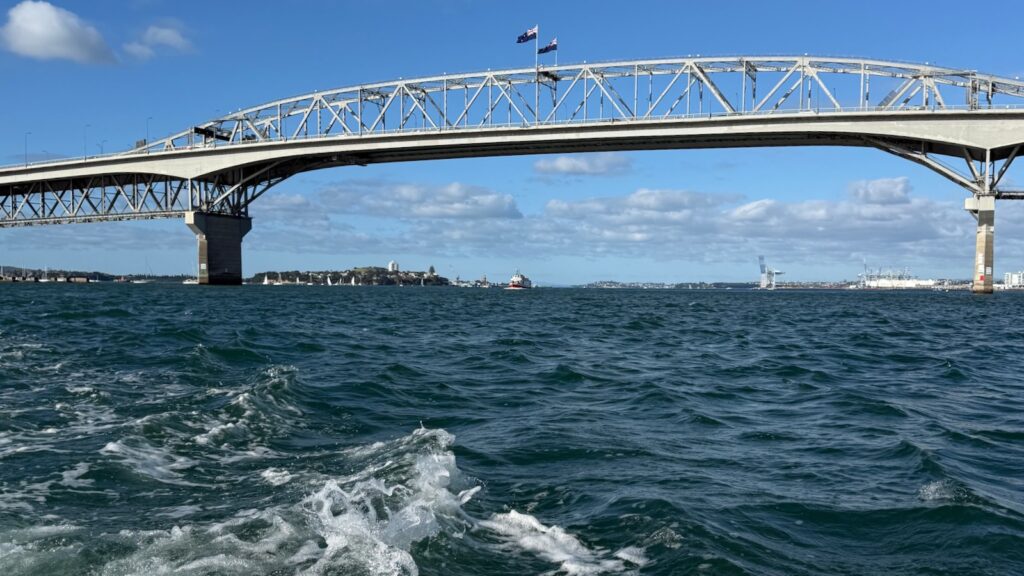
    My sole frustration with the water was, in fact, how slow it all felt — and the fact that I couldn’t get exact distances, so there was an incredible lot of guesswork to do. Did I approach the ferry too close? How long would it take to get to Harbour Bridge? Super aware you can’t just sink massive signposts in the water (very much unlike the highway), there was some impatience my end as I looked towards the Harbour Bridge on the way back — half of me relived, on the water, in my mind, the legendary DHL ad Is It There Yet — as in “were we there yet”? Yet you could tell from my facial expression, I was far from agitated — indeed, I was savouring every moment of total control.

    I’ve always been a “stick person”. I adamantly refused to get automatic cars — my wife helped me pick two cars I loved and still love, the VW C-Trek, and the Dongfeng Fengguang 580 (which ticked my boxes perfectly — six gears, and backseat air-conditioning for the wife). Since my 1998 runs, I’ve held to the throttle and it was all part of being on the water. This time, having a “full”, unrestricted throttle, I treated it with respect — but commanded it with an iron fist. It was pushed down and pulled up with clinical precision — at half-knots, to ensure we were never going too fast, or causing too much a nuisance to others.

    By Harbour Bridge, a larger boat passed us, so there was a fair bit of wake. But preparation was key — pre-launch, I had already downloaded at least six iPhone apps, and done a fair bit of reading on how to handle wakes (an idea was to chop through it at 90°, although now I’ve reduced it to 70° or so). “Chopping” over the waves neutralised their impact on our boat, making for safer sailing (although it was still felt on our hull).

    We returned slightly ahead of time. Incredibly, the run was so exciting, nobody actually used the public conveniences, and apart from a quick snack and drink, we forgot lunch — as this ‘private sailing’ showed us a part of Auckland you usually don’t get to see from those touristy buses! At the dock, there were a few moments when I wasn’t sure if I aligned up properly, as well as a bit of manoeuvring, but ultimately, we were safe back on terra firma. After a final post-run check, we were in the clear. As it was running rather late, we celebrated with a Venti Cappuccino at the Starbucks by Kakano Road — they were open for a bit.