
At age 16 I felt that the Swiss rules for speedboat renting for those without a licence was certainly bordering on the more restrictive. Furthermore, I had a physical deficiency — in spite of goggles and the like, I found it incredibly difficult to keep my head down, in, under the water for anything more than a split second. Fully aware any licensing tests could involve this very move, I intentionally delayed getting such a licence (and was left with much slower boats, or row-/pedal-boats).
The Swiss are remarkably visible in the boating world in spite of us being a landlocked country. Think about it — you associate army knives, chocolates, and epic ski resorts (and brilliant trains, let’s be honest) with our country — the last you’d think of are boats. But we are very present on the boating world — and we have some incredibly demanding tests. Our “blue-ocean” boat licence (the Hochseeausweis) is not a regular licence granted after a RYA Powerboat 2 course — think more a la RYA Yachtmaster Offshore or Ocean as a permit to put our “famously neutral” (although some have since doubted it) white cross on the stern of your ocean-going vessel (and if you have these two RYA tickets, you actually can get it directly converted to our Swiss “blue-ocean” boat licence, apparently).
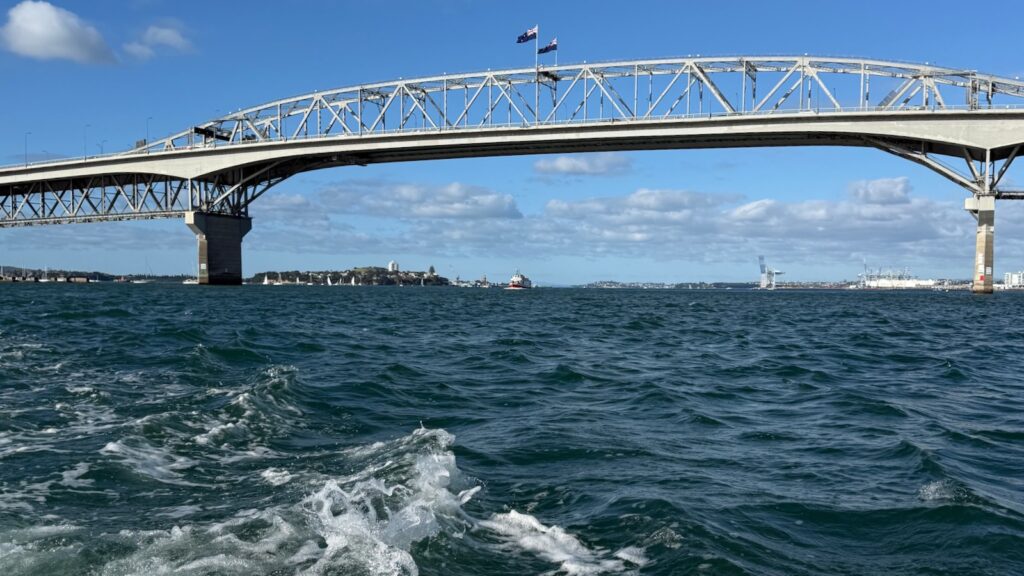
Probably the biggest (and most adventurous) mistake I could have made was to treat Auckland, New Zealand, as “yet another Zürich” when I asked Auckland Boat Hire for a hull our family could rent (which worked!). Throttles in Switzerland were limited without a licence — the one I had on Lake Jinhai in Beijing (under special arrangements) was unlimited (boop!… I felt the thing taking off as I pushed down hard on the throttle). But it was on the waters by the Waitematā where I felt we could go beyond 5 knots for the first time.
it was exciting — but also adventurous. Thank Heavens I treated the pre-launch briefing seriously — this was, to me, not so much “between customer and service provider”, but between two mariners (one with experience, and one slowly building up that). The hull and all gear onboard were examined clinically, and RISK ASSESSMENT was a huge thing. I will admit that the wind did keep us off our planned course from Hobsonville to Half Moon Bay (by a bit)… although there were no serious “close calls”, and I handled the throttle with care (starting smoothly instead of just slamming it down), I felt there were, in retrospect, so much we could improve on.
Almost right after we got home that evening, I was more than interested in how to get behind the helm right — this time, armed with information, and knowledge. I kind of forgot the queries I threw AI (and I did check twice, aware it could hallucinate), but somewhere we ended up talking about boat driver licensing — and BoatUS and its NASBLA Boating Safety ID Card was the first point of call, as all lessons were online, and you got an actual, valid licence. And then right after that was Canada’s PCOC (Pleasure Craft Operator Card) — which proved to be both more understandable, and actually harder with the questions. I did admit to “steering blind” at times — thankfully, the mandatory 24-hour cool-off period gave me plenty of time to review content before a second, and at this time, more successful attempt. (The PCOC proudly sits today right after my Mainland Chinese driving licence for vehicles in my wallet of licences.)
My courses now chart me to more ‘boating tickets’ abroad, including some in Asia, Europe, and Oceania. (Spain’s LN licence is an interesting one, granted to you after just a six-hour course — and there’s nothing wrong with having too many licences!)
The US and Canadian models are open for people the world over — and in the case of the ticket from Florida, free of charge for all from BoatUS — so I would absolutely recommend anyone who thinks of spending time on the water not as a swimmer, to get one. I’m saying this because the language of the water can be different from that one on the highways (although the Cevni signs are extremely user-friendly).
The water doesn’t give you a second chance when you make mistakes, and waves and conditions on the water are actually far more brutal than the most challenging parts of Desert Road on New Zealand’s State Highway 1. If you thought “off-line” (ie: not on the motorway itself) service areas in Ireland or New Zealand were an inconvenience, consider being say stuck somewhere on the fairways in the midst of Hong Kong water with your engine dead! Vessels, and how to pilot them, work massively different to vehicles. A KABOOM! is never a good way to end your journey, but on the water, it can actually be far more serious — and brutal.
I’d like to see, globally, mandatory licensing of all boat operators. This doesn’t have to be an impossible PhD to crack — in fact, Canada and the US are showing how it can be done. It would, then, be far better if you took to the helm at least aware what the water is throwing at you. You can call me a rules-obsessed Bünzli from Zürich, Switzerland — or you can call me an average human being who wants to take his family out on the water — SAFE — with a Vegemite sandwich pre-launch, and return, in one piece, ready for the Cappuccino to close out the sailing…
PS: I was incredibly surprised — relieved, even, when all the speedboat tests did not require me submerging my head under water!…
Leave a Reply